 Image 1 of 1
72pgs Serious Religious Study. The identity, origin, and evolution of Jesus.
The name Jesus is a Middle English transliteration of the Hebrew Joshua, transliterated into Greek. Due to the Greek grammatical rules of declension masculine nominative singular ending with “ους/ous” it’s literally quite impossible to translate any Hebrew word to the Greek Jesus. However, the Middle English version of Jesus, is a near perfect fit. Adding declension “ους” (ous) to the second syllable of Jesus changes the phonetics, pronunciation, and transliteration of Jesus to yesous [Ιησους (G), Iesous (L) or Jesus] and that’s exactly what we see today. This transliteration also fits Jesus within Greco-Roman pagan lore and legends. Particularly, the prophecies of the Sibylline Oracles who spelled Jesus in the Ichthys [ΙΧΘΥΣ]. A name that would consist of four vowels, and two consonants [Ιησους]. Some believe that this historical and/or bizarre turn of events is the fulfilling of pagan prophecy because the name Jesus is “ignotum per ignotius” (like the trinity) and eventually became exactly what the oracles of Apollo had predicted. In short, Jesus was named 1,483-years after the crucifixion because the Greek and Latin alphabets lacked the necessary characters to spell, scribe, or script his name until the 16th century CE (with the exception of 8th century loanwords believed to be forgeries). But this is only the tip of the iceberg, and we have yet to scratch the surface, because Jesus and Ymmanuel are not the same person.
Jesus (1387CE) to yesous [Ιησους (G), Iesous (L)]; pronounced “ee-ay-Soos” (Kione Greek) or “yay-Soos” (modern Greek).
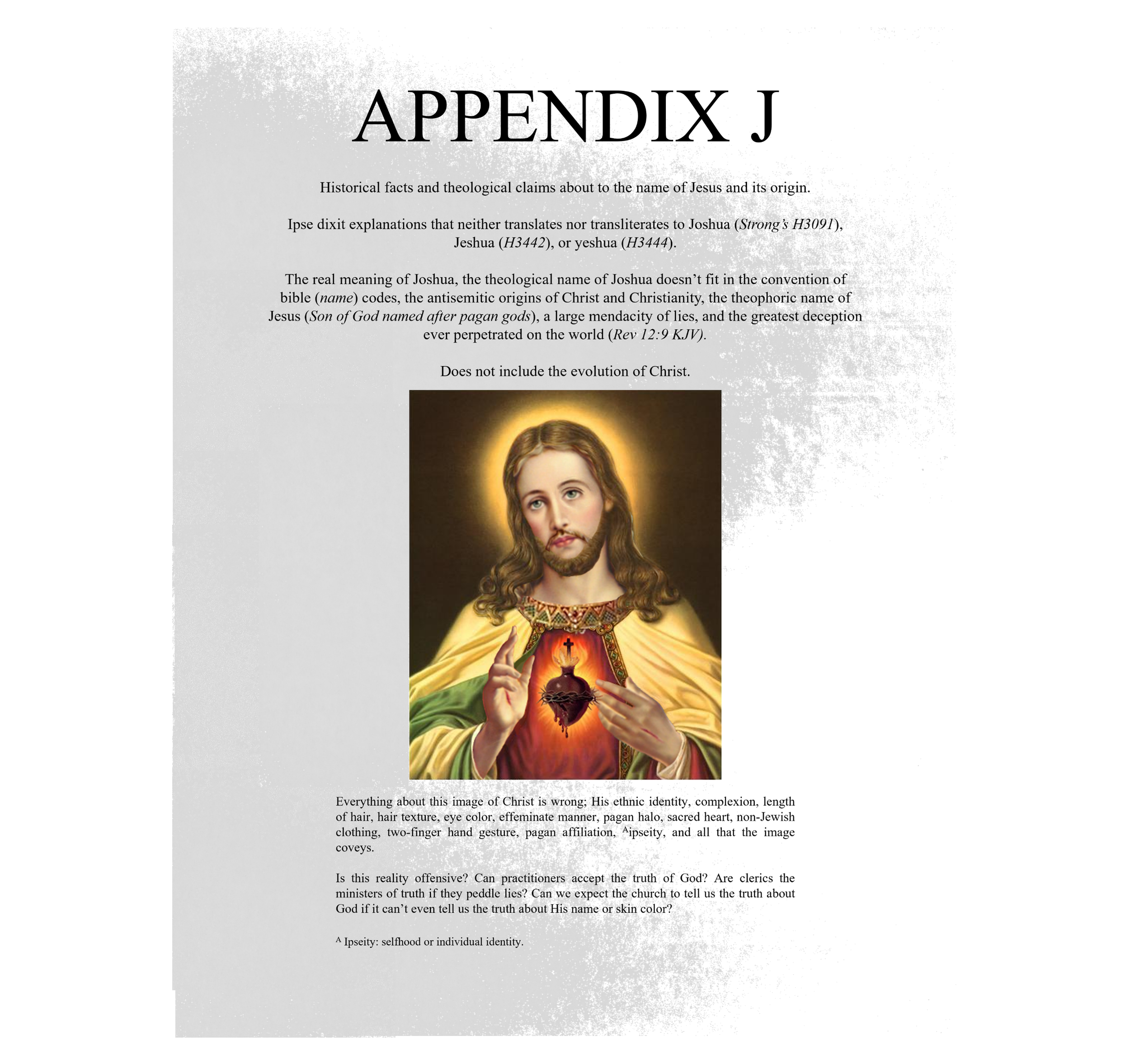
Appendix J is an appendix of a book, the book is a synopsis of a larger work, and the work is multifaceted in prophecies.
72pgs Serious Religious Study. The identity, origin, and evolution of Jesus.
The name Jesus is a Middle English transliteration of the Hebrew Joshua, transliterated into Greek. Due to the Greek grammatical rules of declension masculine nominative singular ending with “ους/ous” it’s literally quite impossible to translate any Hebrew word to the Greek Jesus. However, the Middle English version of Jesus, is a near perfect fit. Adding declension “ους” (ous) to the second syllable of Jesus changes the phonetics, pronunciation, and transliteration of Jesus to yesous [Ιησους (G), Iesous (L) or Jesus] and that’s exactly what we see today. This transliteration also fits Jesus within Greco-Roman pagan lore and legends. Particularly, the prophecies of the Sibylline Oracles who spelled Jesus in the Ichthys [ΙΧΘΥΣ]. A name that would consist of four vowels, and two consonants [Ιησους]. Some believe that this historical and/or bizarre turn of events is the fulfilling of pagan prophecy because the name Jesus is “ignotum per ignotius” (like the trinity) and eventually became exactly what the oracles of Apollo had predicted. In short, Jesus was named 1,483-years after the crucifixion because the Greek and Latin alphabets lacked the necessary characters to spell, scribe, or script his name until the 16th century CE (with the exception of 8th century loanwords believed to be forgeries). But this is only the tip of the iceberg, and we have yet to scratch the surface, because Jesus and Ymmanuel are not the same person.
Jesus (1387CE) to yesous [Ιησους (G), Iesous (L)]; pronounced “ee-ay-Soos” (Kione Greek) or “yay-Soos” (modern Greek).
Appendix J is an appendix of a book, the book is a synopsis of a larger work, and the work is multifaceted in prophecies.